When your team is moving fast, the bag must keep up
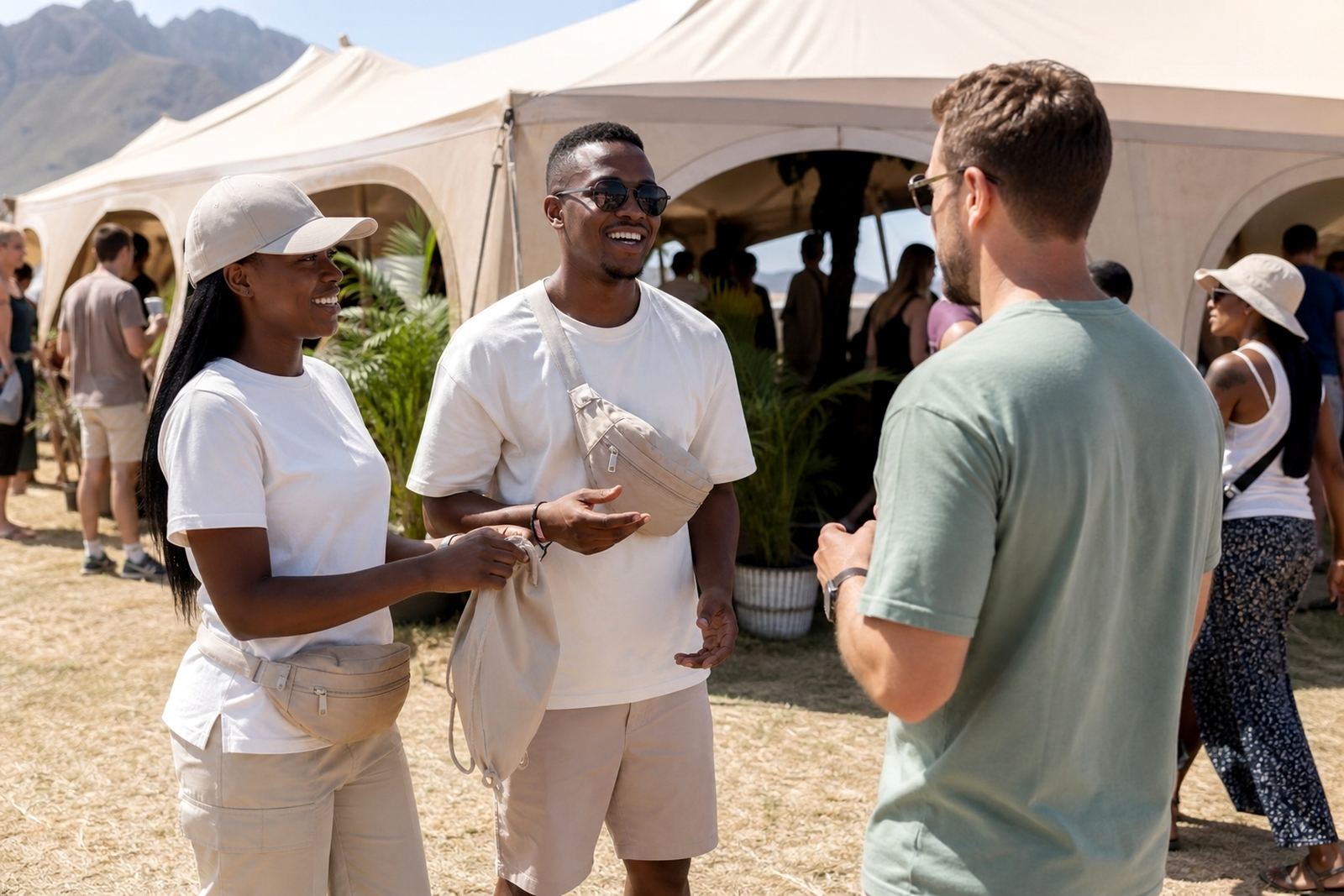
Activation work is different from a standard corporate handout. Your team is walking through crowds, setting up pop-up points, moving between queues and handing out samples in short bursts. The bag has to be easy to open, light enough to wear for hours, and strong enough to take repeated loading without the stitching giving way.
For Cape Town launches, Johannesburg mall activations or Durban beachfront campaigns, we usually see teams needing a clear carry plan for flyers, product sachets, pens, vouchers, lanyards and a few personal items. A good activation bag should sit comfortably, stay visible from a distance and keep the brand face clean. In humid coastal weather the material should not feel soggy after a few hours, and in summer heat it should still hold its shape when packed full.
Typical bag set-ups for sampling and live engagement
Most activation campaigns use a small mix of bag styles rather than one bag for everything. The right choice depends on what the team is carrying, how often the bag is opened, and whether the bag is worn cross-body or handed out to visitors. We help clients plan around the actual event flow, not just the artwork.
- Compact belt bags for hands-free sampling teams and welcome staff
- Cross-body promotional bags for event marshals, runners and brand ambassadors
- Light zip bags for brochures, coupons and point-of-sale items
- Small utility pouches for extra stock, pens, wipes and clipboards
- Bulk-packed bags for onsite distribution or delegate packs
For fast-moving events, the best results usually come from a simple layout with one main compartment, a secure zip and a front panel reserved for logo placement. If the bag is overfilled it becomes awkward to wear and the branding gets hidden, so size matters more than people think.
Branding choices that stay visible in a crowd
Activation bags work best when the logo is easy to read at arm’s length. Strong contrast between bag colour and branding usually gives the best result, especially outdoors or under mixed lighting in exhibition halls. Dark bags with light branding, or light bags with a bold logo, are common for this reason.
We can help with screen printing, heat transfer, embroidery or debossing depending on the bag material and the look you want. Embroidery gives a neat finish on fabric bags, while heat transfer is useful for sharper detail on smaller logo areas. Debossing suits selected synthetic finishes where a clean, low-profile mark is preferred.
- Keep the logo large enough to read from 2 to 3 metres away
- Use one main message rather than crowding the panel
- Allow space for zip pulls, seams and straps so artwork is not cut off
- Check the print colour against the actual bag sample, not only a screen file
Planning the layout before the first bag is packed
A solid activation pack starts with a packing list. We normally ask what will go inside the bag, how many items there are per attendee, whether the team will carry spare stock, and if the same bag must work for both staff use and public handouts. That planning helps us recommend the right size and closure style before production starts.
If your event is split across different cities, the dispatch plan also matters. A campaign in Pretoria and Gqeberha may need separate delivery quantities, pre-counted cartons and clear labelling for each site. Split delivery saves time on the day and reduces the risk of bags going missing in transit. For multi-site activations, it is worth allowing a bit of extra time for quality checks and event kitting so the pack-out is accurate.
Load-shedding can affect timing for last-minute approvals, so it helps to finalise artwork early and keep the printing instructions simple. If you are working to a launch date, plan for a small buffer, especially when the order includes mixed branding methods or custom inserts.
Common mistakes that make activation bags less useful
The most common problem is choosing a bag that looks good on paper but does not suit the event job. A bag that is too small makes the team slow. A bag that is too deep turns into a cluttered hold-all. A bag that is too soft may sag once stock goes in, which makes the brand panel look untidy. People also forget that the bag must be worn for hours, so comfort is just as important as appearance.
Another issue is trying to print too much detail on a small surface. Long taglines, fine lines and busy logos can disappear when the bag is moving. It is better to keep the message direct and readable. We also see delays when clients leave artwork setup to the last minute, or send several versions of the same logo. That slows approval and increases the chance of errors.
- Using a bag size that cannot fit the actual contents
- Placing the logo too close to seams or zips
- Mixing too many colours in one small branding area
- Skipping a sample check before the full run
Budget ranges for activation bags in Rand
Budget depends on bag size, material, branding method and quantity. Small runs cost more per unit, while larger event orders are usually better value. For simple activation bags with one-colour branding, smaller quantities often start from around R45 to R95 each. Mid-range options with better finishing or multi-colour print can sit between R95 and R180 each. Heavier or more detailed branded bags, especially with extra packing or kitting, may move beyond R180 per unit.
For larger campaigns across Cape Town, Johannesburg, Durban, Pretoria or Gqeberha, it is often smarter to compare the total campaign cost rather than only the unit price. That includes packing, split delivery, artwork setup and any rush work. A well-planned bag order can save money on staffing too, because the team spends less time sorting stock onsite.
If you need a fast turnaround, say so upfront. Rush orders are possible on some quantities, but the tighter the lead time the more important it is to keep the spec focused and approve artwork quickly.
How our Montague Gardens team handles activation orders
Our Montague Gardens team works with corporate event planners, marketing managers and activation agencies who need practical bags that look clean on site and perform well under pressure. Lutho Mbekweni oversees the operation, with support from Anika van Rooyen on sales, Sibusiso Dlamini on production, Megan Jacobs on client services, Thabo Molefe on artwork and branding, and Zanele Petersen on dispatch and quality checks. That means each order is followed through from first enquiry to final pack-out.
We also handle sampling, product checks and bulk packing where needed. If your campaign requires bags to be counted, sorted and sent to different venues, we can prepare that in advance so the event team does not waste time on arrival. Clients across Cape Town, Johannesburg, Pretoria, Durban and Gqeberha can start with the enquiry form on our contact page and work from there.